Monday, 31 May 2010

A visit to the health club


Picture this: you've just entered the changing rooms to prepare for your workout. Naturally, as a foreigner, you are an object of curiosity to others in the room. Different body shape! Strange clothes! Speakee the Engrishee! You are slowly getting used to the stares (or crafty use of changing room mirrors), when out of the corner of your eye you spot her - the ajumma. Clad only in her birthday suit, she moves toward you at speed, zeroing in on you like a fat kid on a cupcake. Approaching you, she launches into a long and incomprehensible speech in high-speed Korean about her son who is studying in Boston (Massachubatts, presumably) and peppers you with questions that your present 50-word Korean vocabulary is ill-equipped to deal with. 

A difficult situation under any circumstances, it becomes considerably more traumatic the moment she pauses to present one of two seemingly innocuous objects. That's right - the small Korean gym towel, or the common hairdryer. The former is wielded at both ends and used to vigorously 'floss' mid conversation. The hairdryer -  although an effective conversation stopper - is used to dry between the legs, rather than the head. This is best achieved by placing one foot high up on the counter top - particularly traumatic if you happen to be at close range. 

Let it be said, I have nothing against nudity. However, being verbally accosted by a naked, foreign-language speaking woman who is either flossing or drying in close proximity is certainly an experience. I guess it is things like this that make my time in Korea so memorable ... just another idiosyncrasy in the land of the morning calm.

But, dear readers. It doesn't stop there. Visiting a Korean health club is a very different experience to Western-style gyms for a number of reasons. These include:

  • Micro-towels. No bigger than a tea towel, they don't offer much in the way of coverage, but as discussed, nudity is a totally accepted and expected way of life in Korea. 
  • Showers are communal, and shower rooms look suspiciously like what I expect you might receive at Her Majesty's Pleasure. Dropping the soap probably isn't such a concern however.
  • Generally speaking, nobody breaks a sweat. Vigorous exercise is rare - men come here to pump iron and women come to walk at snails pace on the treadmills and gossip.
  • Cell phones are an essential exercise tool. Towel - check. Workout clothes - check. Water bottle - check. Cell phone - check. If I had a dollar for every time I've seen a workout stopped to answer a phone call or text message I'd be a millionaire. 
  • Women walk backwards on treadmills. Yes, they haven't actually realised the same effect can be achieved using a cross-trainer, without the need for public humiliation. They spend up to half an hour walking backwards, which commands total and utter concentration. One foot wrong and not only will you go shooting off the end and into the lap of the guy on the bike (who's probably on his cell phone and wouldn't notice), you've got an excellent chance of cracking your head open in the process. The very same thing happened last year in my gym, and the woman was knocked unconscious and an ambulance was called.
  • Clothing is provided. Women work out in orange t-shirts and grey shorts, and men wear blue. Interestingly, the men's t-shirts are far too short, but this seems to be the fashion. As a rule, if it doesn't stop around your belly button you're not Korean enough. 
  • Man love is everywhere. Men straddle each other to provide support and spotting when lifting weights. They spend considerable amounts of time in front of the mirrors lifting each other's shorts and shirts to admire, touch and compare muscles. Again, there's nothing wrong with this (and I'm certainly not complaining!), its just something that you really wouldn't find in a western-style gym
  • Some of the machines inside the gym are ... interesting. Vibrating belt machines are all the rage and provide considerable entertainment for yours truly. There is also a strange contraption that allows you to hang upside down for long periods of time. It is not uncommon to see someone leisurely perusing the Korea Times with their feet pointed at the ceiling and blood pooling in their head. If anyone is able to enlighten me as to the health benefits of this I'd be very grateful!
 
Melt away that fat ... or at least entertain those around you while you give it a good jiggle

In short, Korean health clubs are interesting. I find myself with plenty of time to observe as I sit on the bike for my 40-minute solo waygooken spinn class (breaking a sweat even, heaven forbid!). I'll miss my gym when I leave - I quite enjoy a lot of these little idiosyncrasies and I suspect I'll be suffering reverse culture shock on my return home!

Tuesday, 18 May 2010

Desiderata

A thought for the day... clearly not my own, but rather that of the illustrious Max Ehrmann. Food for thought, a little something to warm the heart - chicken soup for the soul. Enjoy!

Go placidly amid the noise and haste,
and remember what peace there may be in silence.
As far as possible, without surrender, be on good terms with all persons.
Speak your truth quietly and clearly; and listen to others,
even to the dull and ignorant; they too have their story.

Avoid loud and aggressive persons, they are vexations to the spirit.
If you compare yourself with others, you may become vain and bitter,
for always there will be greater and lesser persons than yourself.
Enjoy your achievements as well as your plans.

Keep interested in your own career, however humble;
it is a real possession in the changing fortunes of time.
Exercise caution in your business affairs,
for the world is full of trickery.
But let this not blind you to what virtue there is;
many persons strive for high ideals,
and everywhere life is full of heroism.

Be yourself. Especially do not feign affection.
Neither be cynical about love;
for in the face of all aridity and disenchantment
it is as perennial as the grass.

Take kindly the counsel of the years,
gracefully surrendering the things of youth.
Nurture strength of spirit to shield you in sudden misfortune.
But do not distress yourself with dark imaginings.
Many fears are born of fatigue and loneliness.
Beyond a wholesome discipline, be gentle with yourself.

You are a child of the universe no less than the trees and the stars;
you have a right to be here. And whether or not it is clear to you,
no doubt the universe is unfolding as it should.

Therefore be at peace with God, whatever you conceive Him to be.
And whatever your labors and aspirations,
in the noisy confusion of life, keep peace with your soul.

With all its sham, drudgery and broken dreams,
it is still a beautiful world.
Be cheerful. Strive to be happy.

- Max Ehrmann, 1927

Monday, 17 May 2010

A sad goodbye – the curse of Wee Jock Poo Pong McPlop?


So I’ve officially passed the nine-month mark of my contract and have less than three months left in the land of the morning calm. I have to say it is bittersweet – in some respects I am really looking forward to getting home and seeing family and close friends again, but I will also be sad to leave behind life in Korea. Undoubtedly, I am ready to leave. My tolerance has been wearing thin of late, but I guess that’s part and parcel of living in a foreign country and having been ‘on the road’ for almost four years. And possibly old age! I’ve been traveling and living away from home for some time now and I can quite safely say I have gotten the travel bug out of my system – well, at least the long-term strain of it anyway! My return to New Zealand from Korea will include Vietnam, Cambodia, Laos, Malaysia, Borneo and Brunei – a trip I have been wanting to do for quite some time!

It’s funny how easy it is to forget how lucky I am to experience life in another country (or indeed, even ‘life’ at all). Lately I’ve been guilty of perhaps not embracing life quite so much as I should – something I fully intend to do in my remaining three months.

Last week I had an email to tell me that a good friend and former colleague had passed away unexpectedly in London as a result of an accident. Vivacious, vibrant, unique,, infinitely positive and very well known and respected in his field, his death will leave a huge void for many, many people. I’ve never met another person quite like him and possibly never will again. We had our differences at times (both being as stubborn as mules) but he had a heart of gold and was generous almost to a fault. When I broke my leg, he dropped everything at work and came with me in the ambulance to the Royal London Hospital where he sat with me for hours, held my hand, mopped up my tears and tried to lift my spirits with some atrocious jokes until a diagnosis was finally made. I distinctly remember sitting outside the x-ray room awaiting my turn, listening to his tale about how lucky I was not to have broken my femur – in his thick Scottish brogue he vividly recalled how his friend had suffered a broken femur a few years back and he was “hoowlin’ like he’d ne’er heard befoor”, and how it was literally months before he was back on his feet. No sooner had he finished this sobering tale, I was x-rayed and informed that my femur was broken. It was one of the only times I ever saw Greg speechless.

Surely, he was no saint either. To echo the words of his best friend, he was opinionated, uncompromising and perpetually late. He and I were similar in this regard (although I am very rarely late!) and at times his vocal opinions on some issues (including my life!) frustrated me no end. But, that’s what made him who he was. A Scot through and through, a colleague and most importantly, a friend, he will be in my thoughts for a long time to come, and the world is undoubtedly less bright without his presence. I’m sure right now he’s up there, propping up heaven’s bar quoting Robert Burns and giving The Almighty a stern lecture on the state of Scottish football and his sub-standard selection of Scotland’s finest. Rest in peace, Greggie.

Farewell, dear friend ! may guid luck hit you,
And, 'mang her favorites admit you!
If e'er Detraction shone to smit you,
May nane believe him.
And ony De'il that thinks to get you,
Good Lord deceive him.
- Robert Burns

Tuesday, 30 March 2010

Puppy mills in Busan

Further to my previous post, I would like to share with you an 'insight' of sorts into Korea's attitudes to animals. Recently, a puppy farm has been sanctioned in Busan, and is scheduled to open in March. This 'farm' will be used to breed small pet dogs as companion animals of the exact kinds currently filling Korea's over-populated and under-funded animal shelters.

Please take the time to read this - it is heartbreaking, ludicrous and illustrates perfectly the Korean governments attitude to animal welfare in this country.

Note: This article is not my own writing, and has been taken from http://animalrightskorea.org/. It clearly summarises the issues and sets out just how incredibly backward this entire proposal is.

Please also take the time to visit http://www.uniteddogs.com/stopkillingdogs/ and sign the online petition. It takes just a few seconds and your support can make all the difference in the lives of South Korean dogs! 

-----------------------

Here is another astounding move by the Korean government that demonstrates its inept handling of animal welfare in Korea. Puppy mills are set to become part of a national policy!

Several governmental agencies and local administrations are involved in this ludicrous venture, including the Ministry for Food, Agriculture, Forestry and Fishery, the Rural Development Administration, the Gijang-gun Office and the Gijang Agricultural Technology Center in Busan.

The Irresponsible Proposal

With government approval, a so-called Companion Animal Breeding Center is being established at the Agricultural Technology Center in Kijang-kun, Busan. It will open in March.

Typical of the Korean government's focus on generating money rather than raising ethical standards, the Companion Animal Breeding Center is designed as an income source for farmers. It is based on a belief that the companion animal industry will be booming by the next generation.

Breeding will focus the small high-end pet dogs such as Yorkshire Terriers, Maltese dogs and Pomeranians. In other words, it will breed the kinds of dogs that currently live in crowded shelters all over Korea because they have been abandoned by irresponsible owners. This stupid government move will put a tremendous strain on volunteer and welfare agencies like KARA, who are already struggling to help shelters.

According to a spokesman from Agricultural Technology Center, "Once the center is opened, research and development to nurture the industry related with companion animals as a new industry of animal resources shall be fostered." This was said with apparent ignorance of the disaster ahead.

It has been reported that more than 1,000 animals are already at the center, even now before it opens. The health and condition of puppy mill dogs are ignored.

The Lead-Up and Justification

The Rural Development Administration had a hearing on the development of the companion animal industry and relevant officials from related industries, academics, policy departments and others at the National Institute of Animal Science were in attendance. No one thought it prudent to ask any advice from animal welfare groups, or perhaps they did not want to hear it, which gives an idea of the direction the hearing was destined to head in.

At a hearing about the policy, Professor Kim Byung-soo of Gongju National University gave a presentation on the "Trend of Domestic and Overseas Studies of the companion animal" and General Manager Park Yong-hee of Korea Pet Industry Association presented "Prospect of Domestic and Overseas Advancement of the Companion Animal Industry." Other presentations were given, all naturally relating to profit rather than animal welfare.

It was concluded that companion animal breeding will be a growth industry--one that even offers export potential. Much of the forecast of the future relied on the idea that a greater population of singles will exist in the future who will want pets. A rising middle class was another excuse.

The market size of the companion animal industry in Korea is approximately 1 trillion KRW a year, less than 50 trillion KRW in the US and 12 trillion KRW in Japan. Clearly officials are presuming there is room for growth on a massive scale.

President Ra Seung-yong of the National Institute of Animal Science of Rural Development Administration said that, “Research will be undertaken to grow a new animal resource industry based on companion animals,” and he added that, “research will be diversified into the development of food for dogs, transplanting fertilized eggs, reproduction, and so on, starting this year to satisfy the demand of producers and consumers.”

This is the demand the government is hoping does exist or will exist. What Ra Seung-yong is really talking about is big money via a form of expanded animal exploitation. What he does not recognize is that this policy will produce is a national animal welfare disaster.

The Situation Now

Animal protection groups have to spend millions of won to rescue and protect abandoned animals every year. Each group has to raise millions of won by itself because they get no government help. The need for money and the situation for dogs will only get worse.

The Korean government is rushing headlong into a money making scheme without having considered the consequences. It does not seem to have factored into its decision making the reality that thousands of animals are killed by government run shelters every year.

Not only this, it is again going against a global trend in animal welfare. Forward thinking and progressive nations are encouraging and promoting the adoption of abandoned animals to solve their companion animal over-population problems. What does the backward Korean government propose to solve the problem in Korea? Breed more dogs!

The Ministry for Food, Agriculture, Forestry and Fishery is fully aware of the companion animal problems that already exists in Korea. It even announced that the average number of abandoned animals annually is up around 100,000. That's conservative: animal protection groups estimated that the truer figure is up around 700,000 animals abandoned. It is incredible, then, that the ministry should be so irresponsible as to be backing the puppy mill proposal.

Of course, the Ministry for Food, Agriculture, Forestry and Fishery is the one that is far from adequately handling Korea's dog meat industry.

We already have in Korea an unscrupulous pet breeding industry rife with animal abuses. Breeding animals suffer in horrific conditions and surplus animals are killed or eaten.

The current animal protection law prohibits the sales of pet animals less then two month old. But this is ignored. Complaints from pet buyers and conflicts with pet sellers occur all the time. Sales of pet animals on the street or over the Internet are illegal, but government agencies stand by and do nothing.

Regulations on pet breeders and sellers insist on a number of facility-related requirements and training programs. But the enforcement of such regulations has been nonexistent. Even the training and qualification of public servants in charge of these areas is in question.

To date, government mismanagement has resulted in a cycle of animal abandonment and over-population that wastes enormous financial resources of volunteer agencies and tax payers' money. But now it is setting itself up to preside over an "expanded" version of what is already a most intollerable situation.

Response to Protests from the Gijang-gun Office

The English in the follow letter is either original or translated. Either way it is not easy to read. Nonetheless, it gives a good indication of the ignorance abounding in government circles of life in the real world:

We express appreciation with high evaluation for having profound interests on love and protection of pet dog and other companion animals. The companion animal welfare center that this Gijang-gun wishes to undertake is focused on the animal welfare as the partner of valuable life that exchanges the emotion together with people for a long time with sharing of hearts coming from high age and nucleus family trend, not the experimental breeding for the new breeds of companion animal.

The part that you are concerned of, namely, the harassment of animal with the removal of medium not fit to the purpose of breeding process of new type may occur. However, the project that our agricultural technology center undertakes is to select outstanding medium for healthier and more social nature from outstanding dog breeds in the same category that we used the terminology of breeding in broad implication and there is no possibility of euthanasia or anything similar to that at all. For this purpose, an organization is structured and operated with the participation of professor in public health of companion animal, veterinarian, researcher, livestock technician and the like.

Currently, the reality of the pet dog producing farms have lack of conscience and breeding technology on the breed management to cause indiscrete production of hybrid kinds and cross breed today. In addition, the farms have difficulty in importing (or outstanding domestic breeds) of high priced breeding dog.

Consumers who purchased them would treat them as the pet animal rather than thinking as the companion animal that they will be discarded once the effective value declines that the problem of the stray dogs continues without removing such a problem that all people who love animals would share the sentiment. Looking into this aspect, if correct management and production of companion animal is made, the stray animal issue would be solved fundamentally.

Furthermore, before undertaking this project, the farms would be implemented for advance fundamental education in companion dog management, introduction of pet animal theories, animal protection law and the like for the welfare of companion animal and it would educate regularly on companion dog behavior psychology, pathology and others, and it would hold seminars on companion animal welfare from time to time.

In addition, together with those who wish to have the animals, we plan to have the companion animal culture even more matured not to have any animal harassment or inappropriate breeding management together with the socialization training and education of companion dog as well. And, in order to comply with the eight-week pedigree (8주령) of advanced countries of companion animal, sales of pedigree will be sold to purchasers with sufficient qualification.

We know that your heart to love animals and are the same as the heart of us. We hope you to participate with unyielding interest and affection, and we will lead to protect animals. Thank you.

What Should Be Done

Of course, this ridiculous scheme should be abandoned. What the government should be doing is promoting the sale of shelter animals through pet stores and working to re-home abandoned companion animals.

Why isn't this being done? It's simple: the government cannot make money from such an ethical and social service. It has to spend money to do what is essential its job, but it doesn't want to.

The Korean government does not care about animals and it wants welfare agencies to pick up the bill.

Following are contact details for where to submit protests:

Person in Charge of the Project in Gijang County Office
(Agricultural Technology Center)
Kim Tae Su
Tel: 0082-51-709-5310
E-mail : yslee37@busan.go.kr This e-mail address is being protected from spambots. You need JavaScript enabled to view it

Minister For Food, Agriculture, Forestry and Fisheries (MIFAFF)
Mr. Chang,Tae-pyung
Government Complex,
Gwacheon, Jungang-dong,
Gwacheon, Gyeonggi-do
Korea
Email: master@mifaff.go.kr This e-mail address is being protected from spambots. You need JavaScript enabled to view it
Tel: 822- 500-1501~2/ 822-2110-4000

Ministry for Food, Agriculture, Forestry and Fisheries

Government Complex,
Gwacheon, Jungang-dong,
Gwacheon, Gyeonggi-do
Korea
Email: wmaster@mifaff.go.kr This e-mail address is being protected from spambots. You need JavaScript enabled to view it
Tel: 822-503-7200
Fax: 822- 503- 7249

Mayor of Busan Mr. Huh-Nam-shik
(611- 735)
Busan City Hall
051-120, Jungang-ro 2001
Yeonjae- Ku, Busan
Korea
Tel: 8251- 120

Mayor of Gijang- Gun, Busan
(619- 906)
400, Gijang Dae-ro, Gijang-up
Gijang-gun, Busan
Korea
Tel: 8251-709- 4000
Fax: 8251- 709- 4444

Gijang Agriculture Technology Center
Shin-Mun-Go
(120- 705)
New Im-gwang Bldg.,
81 Uijuro, Seodaemun-gu
Seoul, Korea
Tel: 8251- 709- 5303

Rural Development Administration
Administrator Mr. Kim, Jae-soo
(441-707)
Suin-ro, 150, Gwonseon-gu
Suwon city, Gyeonggi-do
Korea
Tel: 8231- 299-2200
Fax: 8231- 299- 2469


Seonwon fashion show!

Some clips from my sixth grade 'fashion show' role play. A lot of fun to make, and the costumes were even more entertaining!

Not bad for 6th graders who are generally 'too cool for school'.

Part I - some of the better presentations


Part II - outtakes, set to the tune of Benny Hill & Sixpence None The Richer.

Monday, 29 March 2010

Canines - cruelty cuisine.

After two frustrated attempts, on Saturday I finally made it out to the Daegu KAPs animal shelter. I rode my new bike out there (cue incitement of bike rage, that's a whole other story). I met Billy at the station and we headed down to the cat house as there seemed to be an abundance of dog walkers available.

To be honest, I found the whole experience a little distressing. There is a large number of cats living at the shelter, the majority of which are suffering from some kind of physical injury or sickness. Despite this, they are friendly, well adjusted and delighted to have some human interaction, even if it's only for a couple of hours. On arrival I knew it was going to be difficult, but it wasn't until I met a little tabby cat who was so sick it's eyes were literally stuck together and it couldn't see a thing. It was coughing and sneezing and clearly unwell but all it wanted was a cuddle. It broke my heart and made me cry - I wanted to take him and each and every other cat home and look after them - cue crazy cat lady, 30 years early!

KAPS (Korean Animal Protection Society) does an incredible job on the little resources they have available. They rely mostly on donations from the public -  both monetary and other resources such as blankets, food and medicine. The stories of abuse and neglect are heartbreaking and enough to leave you wondering just what sort of people we share our world with.

Dog meat is considered a delicacy here in Korea, and like many Korean foods is a 'cure' for many ailments including impotence and poor skin. How it claims to do this is beyond me (how is it different to any other meat?), but in order to get these 'health benefits' the dogs are tortured prior to their deaths to increase the flow of adrenalin in their bodies. Often this is done in front of other dogs - it is well known and understood that dogs can understand the suffering of others, so this is used to the dog-trader's advantage. Dog meat is also 'tenderised' by hanging the dog from a tree and beating it to death. In short, the dog meat trade in Korea is archaic, abhorrent and a sickening crime that should be punishable in an eye-for-an-eye manner.

In a society as modern as today's Korea, there still exists some archaic practices such as this which are founded on nothing but greed and self-fulfillment. The worst part is that even though it is illegal under South Korean law, authorities turn a blind eye and instead the protection of these animals is left in the hands of independent animal welfare groups.  Dog meat dealers have become hostile to those who disapprove and, since the Seoul Olympics of '88 and the increased international awareness of Korean dog farming, many markets now post plain-clothed security guards to keep foreigners away.

Korea is like that friend you know that you can only spend so much time with. Too much and it starts to get on your nerves. When you're feeling positive within yourself, things that would normally drive you crazy are simply passed off as endearing idiosyncrasies. When you're down, even the simplest of frustrations can push you towards that fine line between love and hate and make you want to spend as little time with that friend as possible without cutting them off completely.

At times, Korea is wonderful. Colorful, dynamic and inhabited by some wonderful people that really make you glad to be here. Sometimes though, Korea gets you down. Whether it's something as small as the constant staring and unwanted attention on the street, or the larger things such as animal welfare that really open your eyes and lead you to doubt whether Korea is the modern, progressive country it portrays itself as. Me? I know it happens in all countries, but the degree to which animal cruelty takes place in this country leaves me staggered. Furthermore, Korea gets away with attributing this outright cruelty to 'traditional practices' - "it's what we've always done". It's disgusting, cruel, inhumane and out of step with the rest of the OECD. Get your act together Korea.

"The greatness of a nation and its moral progress can be judged by the way its animals are treated" - Mahatma Gandhi  

An enduring love affair with Taiwan - Part 2

We awoke the following morning and headed to the much-lauded Martyrs Shrine, situated slightly north-east of central Taipei. Constructed back in 1969, the shrine was architecturally inspired by the Hall of Supreme Harmony in Beijing's forbidden city. The site is dedicated to the memory of more than 350,000 Taiwanese soldiers who lost their lives in both the War of Resistance against Japan and the civil war between the Chinese Republican and communist forces. 

View looking from the gate down to the Martyr's Shrine


The temple complex was sprawling and housed several immaculate buildings including a guard house, temple and several smaller buildings of worship. The main attraction at this site is the hourly changing of the guards - a perfectly choreographed and somber affair lasting around ten minutes but well worth hanging around for. We spent some time relaxing in the quite gardens, perusing the scores of plaques lining the walls of the memorial complex. I read many different accounts of heroic, selfless acts committed by the Taiwanese soldiers and it was hard to comprehend that a country like Taiwan which is seemingly so modern and independent could have such a turbulent and bloody history. The English translations of heroicism and bravery were somewhat undermined by the lack of English proofreading - despite the tranquility of the surroundings and the sombre tone of the stories I couldn't help but giggle at some of the wording. For instance, I learned that the Pacific War was in fact initiated by the Japanese in 'Pear Harbour'. Jokes aside, this was one of the highlights of the trip and a definite must-see for anyone visiting Taiwan. 


Kristin arrived later that afternoon, and we headed out for a walk around Ximending to see the sights and sample more of Taipei's ubiquitous bubble tea. Later that evening we headed to the Shilin night markets, however my night ended before it had actually begun thanks to what I can only assume was a dodgy Vietnamese lunch earlier in the day. 


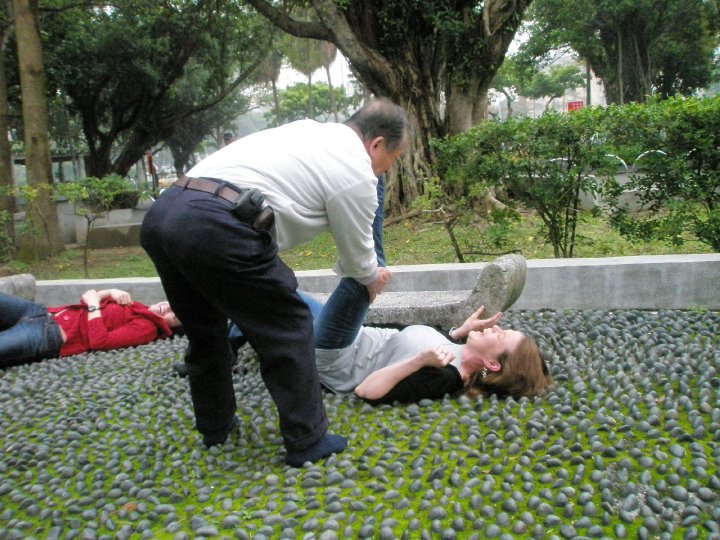
The following morning we rose early and headed to the 228 Peace Memorial Park which was only a stone's throw from our hotel in Ximen. It was a beautiful, tranquil morning and the park was relatively quiet, save for a few squirrels and the odd person relaxing on a park bench. After a walk around the grounds, Kristin and I decided to have a go at walking the stone path, or 'reflexology path'. Designed to target specific areas of the feet, the stones on the path are inlaid pointing upwards (i.e. set in the concrete on their ends rather than on their flattest surface). They are also very, very painful! Kristin and I were quickly joined by an elderly Taiwanese man who seemed intent on having us experience the full reflexology kit and caboodle. Kristin sat and watched whilst I was led at high speed by the hand from one end of the path to the other (and it felt like the longest path in Asia at that point). After my torture was over, he proceeded to take Kristin through a series of exercises - all conducted on the stones - including facial massage, full body stretching and back massage! I was also made to lie on the stones and roll around - he also attempted to stretch my legs above my head but the pain was too much for my poor body. Lying on stones is not as comfortable as it looks! 


 "Let me just bend your completely inflexible leg up above your head. I promise I'll stop if I hear anything snap."


We then headed to the Chiang Kai-Shek memorial hall, just a few stops away on the MRT. The memorial is located in the east end of Liberty Square alongside the national theatre and national concert hall. As with so many things in Chinese culture, symbolism was rife in the design and planning of the memorial hall. The stairs to the memorial itself numbered 89, representing Chiang's age at the time of his death. 


Chiang is a somewhat controversial figure in Taiwanese history and is both revered and loathed by the Taiwanese. He led China successfully during the second Sino-Japanese war but his nationalist government party was defeated by the Chinese Communist Party with the help of Soviet Russia. He was forced to retreat to Taiwan, where he ruled with an iron fist until his death in 1975. Many statues erected in his honor throughout Taiwan have been removed and there has been much argument for the re-naming of the Chiang Kai-Shek memorial hall, however under the current president this is unlikely to happen. 

The following morning after Kate's departure, Kristin and I headed to the Museum of World Religions for a dose of culture. This turned out to be one of our more interesting experiences as we were privileged enough to encounter a helpful man in the subway who not only agreed to show us how to find the building, but also invited us to a special tea and prayer ceremony attended by Taiwanese religious leaders, diplomats and representatives of the ten main world religions. As it transpired, he was actually the President of the Taiwan United Nations organisation and is currently fighting to have Taiwan admitted to the UN independent of China. It was certainly not your average museum visit! 

Despite being an independent country (to all intents and purposes) Taiwan is currently represented in the UN by China as it is not considered to be a sovereign state. Interestingly, I discovered that Taiwan is recognised as an independent sovereign country by only 24 countries around the world. Taiwan's applications to join the World Health Organisation (WHO) and the United Nations have been numerous, but each time have been rejected due to it's status as a 'breakaway province' of China rather than an independent, democratic country. A worthy fight perhaps, but from what I understand is somewhat of a losing battle. 


After the tea and prayer ceremony we dined in the incredible vegetarian restaurant at the museum, and then headed north to Beitou to explore the town and visit the hot pools. We came across a dragon parade, which Kristin decided she had to take part in to win a long-standing bet with a friend of ours. I also joined in, marching in line with the slightly amorous and dentally-challenged locals. It was a beautiful day for it, and very hot! Photographic evidence in hand, we headed out for what we thought was a brisk walk to the thermal valley. We ended up getting rather lost, but eventually found what we were looking for. Hot and sweaty, we headed further north to Danshui, a gorgeous little port town on the outer fringes of Taipei. After much shopping, eating and relaxing in the sun we headed back to central Taipei to relax for the evening. Bliss!


Without a doubt I would go back to Taiwan for another holiday. After spending just seven days in Taipei itself, there were still so many things I didn't get a chance to see. It would also be an incredible place to visit in summer - I would love to head south to the Taroko Gorge and Green Island for some snorkelling, hiking or biking. So far this is my favourite place in all of Asia, beating out Hong Kong for first place (and that's saying something!).


Wednesday, 3 March 2010

An enduring love affair with Taiwan - Part 1


Well, again it has been some time since I have done any updates, however those of you who have complained will now wish you never said a word. I’m in the process of writing up my trip to Taiwan and so far it is set to rival the Yongle Dadian. So grab yourself a coffee, a cheeky biscuit or two and enjoy the first installment.

Before I begin, I probably should set the scene. Personally, I knew little about Taiwan before my visit so will share a fact or two about the country with you prior to boring you senseless with details of my trip.

Taiwan is an independent republic located off the coast of China with a population of around 23 million. It is the second most densely populated country in the world and is largely Buddhist, with a small minority of Christians. The official language is Mandarin, with a minority of people speaking Taiwanese. It is a modern, dynamic country that relies heavily on electronics and machinery exports to survive. Taiwan has a complex political status and is struggling to be seen by the larger international community as an independent republic. They are currently fighting for membership of international organizations including WHO and the UN – China is doing its best to hinder these attempts and refuses to maintain diplomatic relations with any country which formally recognizes Taiwan as the Republic of China.

Scene set!

Escaping the cold weather and drudgery of a semi-refrigerated school with no classes, I headed north to Seoul to begin my first official vacation from Korea. On the assumption I wouldn’t need to pre-purchase a train ticket for mid-week travel to Seoul, I arrived at Dongdaegu station only to find everything inexplicably sold out. I managed to somehow get the last ticket on a train two and a half hours later, so after grabbing a newspaper, coffee and bagel I staked out a spot in the gate lounge and settled in for the afternoon. Fortunately the winter Olympics were playing on the television nearby, so that proved to be a welcome distraction from the journalistic atrocities of the Korea Times.

I was due to fly to Taiwan in the early hours of Thursday morning so I headed to Incheon to stay with a friend on the Wednesday night. I left the apartment around 5.30am on Thursday morning only to find the whole city covered in snow! Not an ideal scenario as it causes havoc with flights – mine was delayed for an hour as there was a significant de-icing queue on the runway. I didn’t mind too much however, as I was luxuriating up in business class perusing the cocktail menu compliments of a free last-minute upgrade from Cathay Pacific!  The one hour delay also lessened the waiting time in Taipei airport, as Kate’s flight got in around 1 hour after mine did. Unfortunately this did mean I had only twenty minutes in which to savor the airport’s tasteful 1960’s decor– it looked like what I imagine Auckland Airport did around 20 years ago.

Incheon Airport, 9am on 25th February. Chilly!

After meeting Kate, we located our bus and headed to downtown Taipei. It was raining solidly, and didn’t stop for the first two and a half days we were there. Not to be deterred, we headed out to explore the Ximen and ShiDa areas, umbrellas at the ready. Our hotel was located right in the heart of the Ximending cultural and shopping district which provided a fantastic base from which to explore. Known as the ‘harajuku of Taipei’, the Ximending area attracts over 3 million shoppers per month, which for a country the size of Taiwan gives you a good indication of its popularity! Interestingly, it is also well known for student prostitution (thanks Wikipedia!).

Ximen district by night - around 1 minutes walk from our hotel!

Later we headed to the National Taiwan Normal University area and visited the ShiDa night markets. We didn’t stay particularly long as it was pelting down with rain, but had a good walk through all the stalls and took temporary refuge from the wet in a Taiwanese restaurant to indulge in beef noodle soup (Kate’s second bowl of the day!).

The following day we headed to the Taipei Fine Arts museum which was quite interesting. Amongst the various exhibitions was an ‘interactive’ piece, whereby you could submit your name and contact details with the chance to participate by ballot. Participation would enable you to join 9 other lucky participants in sitting in a hot tub outside the museum in full view of Taipei’s unsuspecting public. ‘Sittings’ were an hour long, after which time participants would be ready to exit and unleash their pruney white winter bodies to unfortunate museum-goers.. 

I
Inside the Taipei Fine Art Musem


The interactive spa pool installment

After the museum we headed to Beitou, a small town north of central Taipei famous for its natural hot springs. In contrast to the museum ballot, the public baths here provided Kate and I with an open opportunity to expose our white winter bodies – seemingly the other few hundred spa-goers who crammed into the pools with us had the same idea.

Much to our relief (and unlike Korean spas!), Taiwan bathing etiquette requires that you wear a swimsuit at all times. After changing in freezing cold outdoor changing rooms, we jumped into the pools (purely a figure of speech – we daren’t make a splash, lest the ageing lifeguard blows his whistle at us!). Kate managed to incur the wrath of The Whistle when she dared sit on the edge of the hot pool and dangle her feet in the water. We pondered the logic of this for a while until we were informed by someone in the pool that dangling your feet in hot water whilst the rest of your body is cold can draw blood away from your heart and can cause you to faint when you stand up. Fair enough! 

The Beitou public baths

Dinner that night came courtesy of the food court in Taipei’s central MRT station. Not just any old food court either – it was a glorious, unabashed monument to gluttony and a great big middle finger to Kate’s ‘no sugar’ diet. We did a full loop of all of the stores before settling on a Taiwanese restaurant. There were a lot of store options, however many of them involved being able to speak and read Chinese through a complicated pre-ordering system. Well, in all honesty I’m sure the system was very simple, however our extensive vocabulary of ‘thank you’ and ‘hello’ ensured we were unable to order a single thing. The same sorts of places exist here in Korea - I can read the Korean alphabet but Chinese is a whole new ball game! 

Inside one of the food court bakeries - scene of Kate's spectacular fall from the no-sugar wagon

The following day we visited the Longshan temple, which is a famous landmark near central Taipei. Built way back in 1738 by Chinese settlers, it has been destroyed in full and in part over the years by various events such as fires and earthquakes. Its most recent destruction occurred in 1945 during the Taipei Air Raid – it was bombed by the Americans who were convinced it was housing Japanese armaments. Many precious artifacts were destroyed during the raid which also claimed around three thousand (largely civilian) Taiwanese lives. Interestingly, Taiwan’s pro-American political stance means that to this day the bombing has been excluded from history books and media.

After leaving Longshan temple, we wandered through the daytime markets and stumbled across what looked like a quaint little traditional Chinese street. It turned out we were standing on Bopiliao Old Street, which is the most intact street within the previously walled city of Taipei dating back to the Ching dynasty. It had recently been restored and was the film set for ‘Monga’, a recently release Taiwanese gangster movie. We wandered through the restored buildings and courtyards and past the film sets which were filled with gawping fans and tourists. As we were leaving we came across a street artist who was cutting out silhouettes of peoples faces from coloured paper. We stood and watched for a minute, amazed at his ability and attention to detail. Unfortunately a minute was just enough time to be spotted (as a foreigner in Taiwan you generally stand out) and he announced that he was going to do cut-outs for Kate and I for free. We thought this sounded like a great deal, so we accepted. Little did we know he wanted to use us for entertainment purposes and to draw a crowd! He cut, and shouted “Dance! Dance!”. We danced, albeit begrudgingly. The crowd grew larger, and we grew more and more embarrassed. The relief when he finished was palpable – we scurried away, cut-outs in hand. It was embarrassing, but one of those experiences that you just can’t put a price on – something I will always remember! Particularly as it was captured on video…


No visit to Taipei would be complete without a visit to Taipei 101 – formerly the world’s tallest building at 509 metres tall. It has since been bumped to second place by the Khalifa Tower in Dubai which stands at a staggering 828 metres tall. Unfortunately nobody informed the Taipei 101 gift shop, which still sells a wide array of useless souvenirs and knick-knacks proclaiming “Taipei 101: the world’s tallest building”.

The building itself is an amazing feat of engineering and has been designed to withstand typhoons and gale force winds of up to 134 mph, and the strongest earthquakes likely to occur in a 2,500 year cycle. As testament to this, an earthquake measuring 6.8 on the Richter scale struck during construction of the tower, toppling two large cranes from the 56th floor and killing five workers, - the building sustained no structural damage whatsoever and construction resumed almost immediately.

The name ‘Taipei 101’ reflects the one hundred and one floors of the building, which in turn reflect and commemorate the renewal of time – as the tower was being built, a new century arrived (hence 100+1). 100 is also the traditional number of perfection, so 101 symbolises going one step beyond perfection. The main tower is comprised of 8 segments – in Chinese culture the number 8 is associated with good fortune, abundance and prosperity. The entire building has also been designed according to feng shui principles to maximise positive energy. Trust the Chinese to think of everything!

We visited the observation decks on the 89th and 91st floor (indoor and outdoor respectively) and enjoyed incredible views out over Taipei. Unfortunately visibility wasn’t wonderful, but still enabled us to see most of Taipei and its outer limits. We reached the observation decks via the world’s fastest elevator, which travels at around 17 metres per second and is fully pressurized to prevent your ears from popping as you whiz upwards! The interior is also designed to darken on departure and give passengers a view of the ‘night sky’ – cue a chorus of “oooooh! aaaaaah!” from excited tourists. Each elevator costs a paltry US$2.4 million dollars – a bargain! They’re certainly an improvement on the elevators I had the joy of experiencing in Latvia. The floor of the tiny lift quite literally sagged, courtesy of three enormous, loping, out-of-breath American tourists who insisted I hold the lift and wedged themselves in. The minute I felt the floor sag in the middle I tried to fight my way out but was met by an unmoving wall of blubber. I had to make do with propping myself up in the corner on the side rails and praying feverently for my life as we lurched skywards. Approximately 47 minutes later we arrived at the 10th floor where I frantically disembarked, kissed the ground and searched for the nearest stairwell (OK, so it wasn’t quite 47 minutes but it certainly felt like it!) It wasn’t so much a ride in an elevator as an opportunity to see my life flash before my eyes, repent my sins and make an impromptu bucket list! Had I a pen and paper I probably would have jotted out a will just to round things off. 


But, I digress. That evening we wandered through the streets of Ximending, exploring shops and sampling a range of street food ranging from the delicious to the completely unidentifiable. A particular favourite was a Taiwanese spring-onion pancake cooked with your choice of extras (egg, corn, cheese, mystery meat) and spread with a delicious oyster sauce. Despite our best intentions we managed to avoid eating stinky tofu, a Taiwanese specialty. I like tofu as much as the next person and eat it regularly here in Korea, but quite frankly the smell was enough to make even those with the strongest stomachs feel queasy. The smell can only be described as what I imagine a large, fully-populated pet store (stocking mainly dogs and mice) would smell like after two weeks closed up. In hot weather. With no air conditioning. Furthermore after reading about how it is made (compliments of Wikipedia!) I can quite honestly say that I am exceptionally glad that neither a single bite nor atom of stinky tofu came anywhere near my person. For a full, no-holds-barred description of this foul and hideous food click here. I was particularly enamored with the statement “Some less scrupulous stinky tofu factories in China reportedly used rotten kitchen waste, chemical dye and human feces to prepare the brine in order to achieve the odor and texture in short period of time.” Excuse me while I puke.

On the subject of faeces, we also came across a particularly intriguing restaurant in Ximending called ‘Modern Toilet’, which is one of a chain of themed eateries throughout Taiwan (clearly not just a ‘flash in the pan’). In keeping with the name, customers are seated on toilets, dine from mini toilet ‘bowls’ and wipe their hands and faces on toilet rolls hung above the tables. A quirky theme indeed, but their advertising could benefit from a little less of a direct approach (see below). Clearly, patrons of Modern Toilet can see they will dine from a ‘toilet bowl’, but is the graphic illustration of poo really necessary? Perhaps I'm missing the point and it's some sort of delicious Chinese mainland fecal-inspired side dish. We didn’t dine there as we had already eaten, but we spent some time investigating their menus and having a giggle at the advertising and decorating. 


And that's all from me right now ... second installment coming soon!


Monday, 1 February 2010

Okay, okay. An update ...

Well, it has been some time since I posted anything online – mostly because I’ve had very little of note to report! There are a few Korea-related things taking shape in my head right now so once I find the time and words I’ll post something up. In the meantime however, I’ll give a brief rundown of recent happenings here in the ROK.

Christmas was great – some friends and I headed to a city called Daejeon which is a little under an hour away on the train from Daegu. We stayed at one of Korea’s ubiquitous love motels, dined on a Vietnamese Christmas dinner and indulged in some R&R the following day with a visit to the hot springs and Thai massage (when in Korea…)

New Years Eve was spent in Seoul with a large group of friends from the EPIK program. Eleven of us boarded the KTX on New Years Eve and headed north into plunging temperatures. – New Year’s Eve was the coldest day Seoul had seen the entire winter and we rang in the New Year in Pavilion Square rugged up against the -18 degree temperatures (that’s zero Fahrenheit for the Americans). After midnight we headed to Hongik University district where we met up with a large group of fellow EPIK and hagwon teachers and spent the night drinking, chatting and wound up the celebrations with a visit to a luxury noraebang (karaoke house). The following day we went to Lotte World, which is an enormous indoor theme park/shopping mall/monument to Western capitalism – bought to you by everyone’s favourite East Asian industrial conglomerate - Lotte! Some of the attractions included an indoor theme park, ice skating rink, bowling, indoor shooting range, video arcades, western-themed restaurants, souvenir shops and a folk museum. Hours of endless fun for millions of Koreans, and even more fun for Westerners observing said Koreans on the ice rink.

My time in January has largely been spent teaching English classes at other schools (known as ‘camps’) and battling technology problems. I worked at three separate English camps over the break, including one at my own school. One of the schools I worked at asked all of the students to give themselves an English name and as you can imagine there were some absolute pearlers. Notable examples include Puzzle, Bad Boy, Spring and Summer (all boys), and Ice, People and Cream (all girls). At the end of the camp students were asked to write a letter to one of the native English teachers on the camp. I got a bundle of letters with some wonderful quotes and sweet sentiments – namely “you have a boyish face” , “tell me how to get a small face like you” and “why aren’t you married?”.

It also snowed like crazy on the first day of my first camp – see pictures below. It was the first and (hopefully) only snow of the Daegu winter, but boy was it a good one! I had to walk home in the snow that day as the school I was teaching at was located deep in a valley and buses and cars were ill-prepared for the snow and unable to drive up the hill. It was a treacherous 4 kilometer walk home but again, a novelty so I didn’t mind it too much at all. Goodness knows I need the exercise.


Last weekend a group of us headed north to the Taebaek Snow Festival, which took place at Mt Taebaek up near the North Korean border. The website for the festival made it sound like great fun, and a day not to be missed. On arrival we found some snow carvings and sculptures, some largely disappointing sled tracks for small children, and one dog sled capable of carrying up to two waif-like children. One of the highlights for me was the ice café – a giant igloo in which you could purchase a coffee and drink it at the frozen chairs and tables. A little cold on the butt, but definitely a novelty. Later in the afternoon James decided to liven things up by face-planting on a frozen river – by some miracle he didn’t break his nose although the small cut on his forehead bled profusely. He also acquired a most attractive ‘trout pout’ when his teeth cut into his lips on impact. As usual the practical Koreans had an ideal remedy for his head injury – a sticking plaster and some panadol. After a fall like that I’m surprised they didn’t treat it with more caution as he really gave it a good knock. Still, overall it was a nice day out – definitely worthwhile just to inhale some clean mountain air as opposed to the usual Korean city smog and haze.


The ice cafe

 
 The outside of the ice cafe


And coming up over the next month … Taiwan! I leave Daegu on the 17th of February and head to Seoul where I’ll be staying with Drew for a night and catching an early flight to Taipei on the 18th to meet my sister Kate. Friend and fellow EPIKer Kristin arrives on the Sunday and we’ll be around and about Taipei until the following Thursday. At the moment it looks like I’ll be staying on in Seoul for Joanne’s birthday but have yet to finalise anything. Bring on the travel, it’s been far too long!

Wednesday, 16 December 2009

Waiting for love


Last week I was privileged enough to spend some time volunteering at an orphanage here in Daegu. After contacting the orphanage via email to enquire as to volunteering opportunities I was invited to attend their annual Christmas party for games, pizza, carols and a movie.

To be honest I really didn’t know what to expect. I had no idea of their ages or individual circumstances or even what sort of organization the orphanage was. On Saturday afternoon I arrived at Ansim station where I met Todd, who is heavily involved with the orphanage and the local church. We also met several of the other volunteers and then headed over to the orphanage.

The building itself is located on the outskirts of Daegu in what appears to be a much lower socio-economic part of town. Slightly run down, it may have been a school in a former life although it is difficult to tell. It is in a slightly industrial area, which no doubt ensures a reasonable level of rent (assuming any is paid of course) and fronts onto a large and dusty outdoor recreation area and car park.

The kids were shy at first but quickly warmed up to the new faces – even the quietest of them were running around like lunatics and begging for piggyback rides. It was great to see their personalities coming out, as there were some rather nervous looking kids when we first arrived. Members of the local church began to trickle in throughout the afternoon along with local Korean teachers who also volunteer at the orphanage – some even living there full time to help care for the kids. The relationships between these teachers and church members appeared very strong and it was clear that these are very important people in their lives. After meeting with a lot of them and speaking to them you can’t help but wonder if these kids are in a better place now than they ever have been. The volunteers I spoke with were all kind, generous, intelligent, cheerful and infinitely patient. What better role models could you ask for given the circumstances?

Throughout the afternoon we played games, watched some performances by the kids and even staged a performance of our own. After carol time Santa made an appearance and gave each of the children a present which they were absolutely thrilled with. One of the little boys received a remote-controlled toy car which went down an absolute treat. He stopped playing with only long enough to jam a couple of pieces of pizza into his mouth before resuming ramming it into peoples ankles and mastering the art of the wheelie.


One little boy was absolutely adorable, and it broke my heart to think that someone out there simply didn’t want him, or his seven year old sister who was also at the orphanage. Apparently his parents split up and decided that neither of them wanted the kids so they simply gave them to the orphanage and moved on. He was a dear little boy with a very laid back and adaptable personality. At only 20 months old it was both fortunate and sad that he was so comfortable in the presence of so many strangers – whether this is testament to his personality or his unstable upbringing I do not know. His sister seemed very much the same – a very pretty little girl who was friendly and eager to participate in everything from singing to games to cleaning up afterwards.

Mi Young - aged 20 months


Oh boy, a present from Santa!

Looking at these kids it was hard to believe that some of them have had such turbulent pasts. I have no idea of the backgrounds of most of them, but for the most part the parents have generally split up and decided that neither of them wants to take the children. Or, in a number of cases the children have been left with the mother who is often young and generally unable to support them financially. A very sad situation indeed and one I find difficult to understand, particularly given some rather contradictory aspects of Korean culture.

On one hand, Korea is a very harmonious and collective culture and it could be argued that they look after their families far better than the majority of western countries. On the other hand, Korea is also a culture built on social hierarchies: where respect and obedience is critical to maintaining social harmonies. Any deviation from the expected social plan (i.e. school, university, marriage, children, and career) is considered shameful, particularly where children are concerned.

To be an unmarried mother in Korea is considered immoral and deplorable. These mothers are considered to be the lowest rung on the societal ladder, are socially ostracized and often alienated from their own families as a result. Unwed mothers are regularly turned down for jobs. There is no getting around this, as to not disclose this fact will only lead to accusations of dishonesty and termination of their contracts. The government takes a similar view – children born out of wedlock are entitled to only around US$45 a month in support. Korean children adopted into Korean families are entitled to US$85 a month. Incredible when you think how much money the government must give in order to subsidize the large number of orphanages throughout the country.

The government is trying to increase financial benefits for unmarried mothers but social stigma is proving to be a huge barrier. Nobody will come forward to claim these benefits – they would sooner have an illegal abortion or have their child in secret and relinquish it to an orphanage rather than face a lifetime of stigma at the hands of general society.

More recently, Korea’s first unwed mothers support network has been established – the first of its kind in the country. It is incredible to think that a country would sooner ostracize members of society and adopt its children internationally rather than provide the necessary support for women who genuinely need it. With any luck this organization (and future organizations) will, in time, help to remove - or at least lessen - the stigma of unmarried mothers.  In turn, the need for so many orphanages will no longer exist and the lives of so many women and children will not be so miserable. We can but hope.

If you want to read more on this topic I recommend checking out this article – a fascinating insight from both an unwed mother and a Korean adoptee. This is also a great article – a little older, but the sentiments and attitudes it speaks of are still rife in Korea.  Older still but equally as fascinating is this piece from the South China Morning Post (20/06/98) which refers to some orphans as ‘IMF orphans’, in reference to the IMF’s Korean bailout back in 1997 which was blamed by many for the economic downturn.

Me – I have signed up to volunteer regularly at the orphanage as an English teacher and as a general lackey. These kids need and deserve every opportunity in life and if I can do just a tiny little bit to help it’s got to count for something. Besides – who doesn’t relish the opportunity to be a big kid once in a while?

Singing Christmas carols in English

Having a treat - Dunkin' Donuts in the playhouse


Rugrat central


The Christmas feast put on by the orphanage


One of the evening's Christmas performances